četvrtak, 12. siječnja 2017.

Bosnia and Herzegovina

Flag of Bosnia and Herzegovina


Bosnia and Herzegovina (Listeni/ˈbɒzniə ənd ˌhɛərtsəɡoʊˈviːnə, - ˌhɜːrt-, - ɡə-/or/ˌhɜːrtsəˈɡɒvᵻnə/;[10][11] Bosnian, Croatian and Serbian Latin script: Bosna i Hercegovina, Bosnian and Serbian Cyrillic script: Боснa и Херцеговина; claimed [bôsna i xěrt͡seɡoʋina]), once in a while called Bosnia-Herzegovina or Bosnia and Herzegovina, shortened BiH or B&H, and, to put it plainly, frequently referred to casually as Bosnia, is a nation in Southeastern Europe situated on the Balkan Peninsula. Sarajevo is the capital and biggest city. Circumscribed by Croatia toward the north, west, and south; Serbia toward the east; Montenegro toward the southeast; and the Adriatic Sea toward the south, with a coastline around 20 kilometers (12 miles) in length encompassing the city of Neum. In the focal and eastern inside of the nation the geology is uneven, in the northwest it is decently sloping, and the upper east is prevalently flatland. The inland is a geologically bigger area and has a direct mainland atmosphere, with hot summers and cool and frigid winters. The southern tip of the nation has a Mediterranean atmosphere and plain geology.

Bosnia and Herzegovina is a locale that follows lasting human settlement back to the Neolithic age, amid and after which it was populated by a few Illyrian and Celtic civic establishments. Socially, politically, and socially, the nation has a rich history, having been initially settled by the Slavic people groups that populate the range today from the sixth through to the ninth hundreds of years. In the twelfth century the Banate of Bosnia was built up, which advanced into the Kingdom of Bosnia in the fourteenth century, after which it was added into the Ottoman Empire, under whose govern it would stay from the mid-fifteenth to the late nineteenth hundreds of years. The Ottomans conveyed Islam to the area, and modified a significant part of the social and social standpoint of the nation. This was trailed by addition into the Austro-Hungarian Monarchy, which kept going up until World War I. In the interwar period, Bosnia was a piece of the Kingdom of Yugoslavia and after World War II, the nation was allowed full republic status in the recently framed Socialist Federal Republic of Yugoslavia. Taking after the disintegration of Yugoslavia, the nation declared freedom in 1992, which was trailed by the Bosnian War, enduring until late 1995.

Today, the nation keeps up high proficiency, future and training levels and is a standout amongst the most every now and again went to nations in the region,[12] anticipated to have the third most astounding tourism development rate on the planet in the vicinity of 1995 and 2020.[13] Bosnia and Herzegovina is territorially and universally eminent for its common excellence and social legacy acquired from six recorded human advancements, its cooking, winter dons, its mixed and one of a kind music, design and its celebrations, some of which are the biggest and most unmistakable of their kind in Southeastern Europe.[14][15] The nation is home to three primary ethnic gatherings or, authoritatively, constituent people groups, as determined in the constitution. Bosniaks are the biggest gathering of the three, with Serbs second and Croats third. A local of Bosnia and Herzegovina, paying little respect to ethnicity, is distinguished in English as a Bosnian. The terms Herzegovinian and Bosnian are kept up as a local instead of ethnic refinement, and the area of Herzegovina has no unequivocally characterized fringes of its own. In addition, the nation was just called "Bosnia" until the Austro-Hungarian occupation toward the finish of the nineteenth century.[16]

Bosnia and Herzegovina has a bicameral governing body and a three-part Presidency made out of an individual from every significant ethnic gathering. Be that as it may, the focal government's energy is very constrained, as the nation is to a great extent decentralized and includes two independent elements: the Federation of Bosnia and Herzegovina and Republika Srpska, with a third area, the Brčko District, administered under neighborhood government. The Federation of Bosnia and Herzegovina is itself complex and comprises of 10 government units – cantons. The nation is a potential possibility for participation to the European Union and has been a contender for North Atlantic Treaty Organization enrollment since April 2010, when it got a Membership Action Plan at a summit in Tallinn.[17] Additionally, the nation has been an individual from the Council of Europe since April 2002 and an establishing individual from the Mediterranean Union upon its foundation in July 2008.

The initially safeguarded broadly recognized specify of Bosnia is in De Administrando Imperio, a politico-geological handbook composed by the Byzantine head Constantine VII in the mid-tenth century (in the vicinity of 948 and 952) depicting the "little land" (χωρίον in Greek) of "Bosona" (Βοσώνα).[18] The name is accepted to have been gotten from the hydronym of the waterway Bosna coursing through the Bosnian heartland. As indicated by philologist Anton Mayer the name Bosna could be gotten from Illyrian "Bass-an-as" which would be a redirection of the Proto-Indo-European root "bos" or "bogh", signifying "the running water".[19] According to English medievalist William Miller the Slavic pilgrims in Bosnia "adjusted the Latin assignment [...] Basante, to their own figure of speech by calling the stream Bosna and themselves Bosniaks [...]".[20]

The name Herzegovina ("herzog's [land]", from German word for "duke")[19] begins from Bosnian head honcho Stephen Vukčić Kosača's title, "Herceg (Herzog) of Hum and the Coast" (1448).[21] Hum, some time ago Zahumlje, was an early medieval territory that was vanquished by the Bosnian Banate in the main portion of the fourteenth century. The locale was controlled by the Ottomans as the Sanjak of Herzegovina (Hersek) inside the Eyalet of Bosnia up until the development of the brief Herzegovina Eyalet in the 1830s, which was remerged in the 1850s, after which the substance turned out to be regularly known as "Bosnia and Herzegovina".

On beginning declaration of freedom in 1992, the nation's legitimate name was the Republic of Bosnia and Herzegovina however taking after the 1995 Dayton Agreement and the new constitution that went with it the name was authoritatively changed to Bosnia and Herzegovina.

Bosnia is situated in the western Balkans, flanking Croatia (932 km or 579 mi) toward the north and west, Serbia (302 km or 188 mi) toward the east, and Montenegro (225 km or 140 mi) toward the southeast. It has a coastline around 20 kilometers (12 miles) in length encompassing the city of Neum.[22][23] It lies between scopes 42° and 46° N, and longitudes 15° and 20° E.

Topographic guide of Bosnia and Herzegovina

Bosna waterway, Ilidža

The nation's name originates from the two areas Bosnia and Herzegovina, which have an enigmatically characterized fringe between them. Bosnia possesses the northern territories which are around four-fifths of the whole nation, while Herzegovina involves the rest in the southern part of the nation.

The nation is for the most part hilly, enveloping the focal Dinaric Alps. The northeastern parts venture into the Pannonian Plain, while in the south it fringes the Adriatic. The Dinaric Alps by and large keep running in a southeast-northwest heading, and get higher towards the south. The most elevated purpose of the nation is the pinnacle of Maglić at 2,386 meters (7,828.1 feet), on the Montenegrin outskirt. Real mountains incorporate Kozara, Grmeč, Vlašić, Čvrsnica, Prenj, Romanija, Jahorina, Bjelašnica and Treskavica.

In general, near half of Bosnia and Herzegovina is forested. Most backwoods zones are in the inside, east and west parts of Bosnia. Herzegovina has drier Mediterranean atmosphere, with predominant karst geology. Northern Bosnia (Posavina) contains exceptionally fruitful agrarian land along the River Sava and the comparing region is vigorously cultivated. This farmland is a part of the Pannonian Plain extending into neighboring Croatia and Serbia. The nation has just 20 kilometers (12 miles) of coastline,[22][24] around the town of Neum in the Herzegovina-Neretva Canton. In spite of the fact that the city is encompassed by Croatian landmasses, by worldwide law, Bosnia and Herzegovina has a privilege of section to the external ocean.

Sarajevo is the capital[1] and biggest city.[3] Other real urban areas are Banja Luka in the northwest locale known as Bosanska Krajina, Bijeljina and Tuzla in the upper east, Zenica and Doboj in the focal piece of Bosnia and Mostar, the biggest city in Herzegovina.

There are seven noteworthy streams in Bosnia and Herzegovina:[25]

The Sava is the biggest stream of the nation, and structures its northern characteristic outskirt with Croatia. It channels 76%[25] of the nation's region into the Danube and afterward the Black Sea. Bosnia and Herzegovina is in this way additionally an individual from the International Commission for the Protection of the Danube River (ICPDR).

The Una, Sana and Vrbas are correct tributaries of Sava waterway. They are situated in the northwestern locale of Bosanska Krajina.

The Bosna stream gave its name to the nation, and is the longest waterway completely contained inside it. It extends through focal Bosnia, from its source close Sarajevo to Sava in the north.

The Drina courses through the eastern piece of Bosnia, and generally it frames a characteristic outskirt with Serbia.

The Neretva is the real stream of Herzegovina and the main significant waterway that streams south, into the Adriatic Sea.

Phytogeographically, Bosnia and Herzegovina has a place with the Boreal Kingdom and is shared between the Illyrian area of the Circumboreal Region and Adriatic region of the Mediterranean Region. As indicated by the World Wide Fund for Nature, the region of Bosnia and Herzegovina can be subdivided into three ecoregions: the Pannonian blended backwoods, Dinaric Mountains blended timberlands and Illyrian deciduous woodlands.

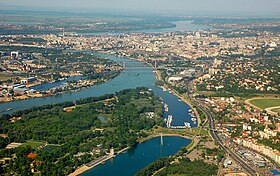
Belgrade


Belgrade iz balona.jpg(/ˈbɛlɡreɪd/chime review; Serbian: Beograd/Београд; Serbian articulation: [beǒɡrad] ( tune in); names in different dialects) is the capital and biggest city of Serbia. It is situated at the intersection of the Sava and Danube waterways, where the Pannonian Plain meets the Balkans.[5] Its name means "White city". The urban range of the City of Belgrade has a populace of 1.34 million, while more than 1.65 million individuals live inside its managerial limits.[1]
A standout amongst the most vital ancient societies of Europe, the Vinča culture, developed inside the Belgrade region in the sixth thousand years BC. In days of yore, Thraco-Dacians occupied the district, and after 279 BC Celts vanquished the city, naming it Singidūn.[6] It was vanquished by the Romans amid the rule of Augustus, and granted city rights in the mid-second century.[7] It was settled by the Slavs in the 520s, and changed hands a few circumstances between the Byzantine Empire, Frankish Empire, Bulgarian Empire and Kingdom of Hungary before it turned into the capital of Serbian ruler Stephen Dragutin (1282–1316). In 1521, Belgrade was vanquished by the Ottoman Empire and turned into the seat of the Sanjak of Smederevo.[8] It much of the time go from Ottoman to Habsburg govern, which saw the decimation of the greater part of the city amid the Austro-Ottoman wars. Belgrade was again named the capital of Serbia in 1841. Northern Belgrade remained the southernmost Habsburg post until 1918, when the city was brought together. As a vital area, the city was combat over in 115 wars and destroyed 44 times.[9] Belgrade was the capital of Yugoslavia from its creation in 1918, to its last disintegration in 2006.

Belgrade has an exceptional regulatory status inside Serbia[10] and it is one of five measurable locales of Serbia. Its metropolitan domain is partitioned into 17 districts, each with its own particular neighborhood council.[11] City of Belgrade spreads 3.6% of Serbia's region, and 22.5% of the nation's populace lives inside its managerial points of confinement. It is named a Beta-worldwide city.Chipped stone instruments found at Zemun demonstrate that the region around Belgrade was possessed by traveling foragers in the Paleolithic and Mesolithic periods. Some of these instruments have a place with the Mousterian business, which are connected with Neanderthals instead of cutting edge people. Aurignacian and Gravettian apparatuses have likewise been found there, showing occupation in the vicinity of 50,000 and 20,000 years ago.[14]

The primary cultivating individuals to settle in the district are connected with the Neolithic Starčevo culture, which thrived in the vicinity of 6200 and 5200 BC.[15] There are a few Starčevo locales in and around Belgrade, including the eponymous site of Starčevo. The Starčevo culture was prevailing by the Vinča culture (5500–4500 BC), a more modern cultivating society that became out of the before Starčevo settlements which is additionally named for a site in the Belgrade area (Vinča-Belo Brdo). The Vinča culture is known for its expansive settlements, one of the most punctual settlements by constant residence and a portion of the biggest in ancient Europe;[16] human puppets, for example, the Lady of Vinča; the soonest known copper metallurgy in Europe;[17] a proto-written work shape created preceding the Sumerians and Minoans, known as the Old European script, going back to around 5300 BC.[18]

Antiquity[edit]

Proof of early learning about Belgrade's geological area originates from antiquated myths and legends. The stone sitting above the juncture of the Sava and Danube waterways has been recognized as one of the place in the tale of Jason and the Argonauts.[19][20] The Paleo-Balkan tribes of Thracians and Dacians ruled this zone preceding the Roman conquest.[21] Belgrade was possessed by a Thraco-Dacian tribe Singi;[6] after the Celtic intrusion in 279 BC, the Scordisci took the city, naming it "Singidūn" (dūn, fortress).[6] In 34–33 BC the Roman armed force drove by Silanus achieved Belgrade. It turned into the romanized Singidunum in the first century AD, and by the mid-second century, the city was declared a municipium by the Roman powers, advancing into an undeniable colonia (most elevated city class) before the finish of the century.[7] Apart from the principal Christian Emperor of Rome who was conceived in the domain of present day Serbia in Naissus—Constantine I known as Constantine the Great[22]—another early Roman Emperor was conceived in Singidunum: Flavius Iovianus (Jovian), the restorer of Christianity.[23] Jovian restored Christianity as the official religion of the Roman Empire, finishing the brief restoration of conventional Roman religions under his ancestor Julian the Apostate. In 395 AD, the site go toward the Eastern Roman or Byzantine Empire.[24] Across the Sava from Singidunum was the Celtic city of Taurunum (Zemun); the two were associated with an extension all through Roman and Byzantine times.[25]

Center Ages[edit]

World War II[edit]

On 25 March 1941, the administration of official Crown Prince Paul marked the Tripartite Pact, joining the Axis controls with an end goal to remain out of the Second World War and keep Yugoslavia nonpartisan amid the contention. This was instantly trailed by mass challenges in Belgrade and a military rebellion drove via Air Force leader General Dušan Simović, who declared King Peter II to be of age to govern the domain. Thus, the city was vigorously besieged by the Luftwaffe on 6 April 1941, murdering up to 24,000 people.[68][69] Yugoslavia was then attacked by German, Italian, Hungarian, and Bulgarian strengths. Belgrade was involved by the German Army later that month and Belgrade turned into the seat of the manikin Nedić administration, headed by General Milan Nedić.[70]

German besieging of Belgrade in 1941

Amid the mid year and fall of 1941, in backlash for guerrilla assaults, the Germans did a few slaughters of Belgrade nationals; specifically, individuals from the Jewish people group were liable to mass shootings at the request of General Franz Böhme, the German Military Governor of Serbia. Böhme thoroughly upheld the decide that for each German executed, 100 Serbs or Jews would be shot.[71] The resistance development in Belgrade was driven by Major Žarko Todorović from 1941 until his capture in 1943.[72]

Much the same as Rotterdam, which was crushed twice, by both German and Allied bombarding, Belgrade was besieged yet again amid World War II, this time by the Allies on 16 April 1944,[why?] killing no less than 1,100 individuals. This bombarding fell on the Orthodox Christian Easter.[73] Most of the city stayed under German occupation until 20 October 1944, when it was freed by the Red Army and the Communist Yugoslav Partisans. On 29 November 1945, Marshal Josip Broz Tito announced the Federal People's Republic of Yugoslavia in Belgrade (later to be renamed to Socialist Federal Republic of Yugoslavia on 7 April 1963).[74] Higher evaluations from the previous mystery police put the casualty include of political mistreatments Belgrade at 10,000.[75]

Belgrade lies 116.75 meters (383.0 ft) above ocean level and is situated at the intersection of the Danube and Sava waterways. The verifiable center of Belgrade, Kalemegdan, lies on the correct banks of both streams. Since the nineteenth century, the city has been extending toward the south and east; after World War II, Novi Beograd (New Belgrade) was based on the left bank of the Sava stream, interfacing Belgrade with Zemun. Littler, mainly private groups over the Danube, as Krnjača, Kotež and Borča, additionally converged with the city, while Pančevo, a vigorously industrialized satellite city, remains a different town. The city has a urban territory of 360 square kilometers (140 sq mi), while together with its metropolitan range it covers 3,223 km2 (1,244 sq mi)

Belgrade lies in the sticky subtropical (Cfa) barely shy of a Humid mainland atmosphere (Dfa), atmosphere zone, with four seasons and consistently spread precipitation. Month to month midpoints extend from 1.4 °C (34.5 °F) in January to 23.0 °C (73.4 °F) in July, with a yearly mean of 12.5 °C (54.5 °F). There are, by and large, 31 days a year when the temperature is over 30 °C (86 °F), and 95 days when the temperature is over 25 °C (77 °F). Belgrade gets around 690 millimeters (27 in) of precipitation a year, with late spring being wettest. The normal yearly number of sunny hours is 2,112.

The most noteworthy authoritatively recorded temperature in Belgrade was +43.6 °C (110.5 °F) on 24 July 2007,[88] while on the flip side, the least temperature was −26.2 °C (−15 °F) on 10 January 1893.[89]

Belgrade is a different regional unit in Serbia, with its own self-sufficient city authority.[10] The Assembly of the City of Belgrade has 110 individuals, chose on four-year terms.[91] A 13-part City Council, chose by the Assembly and directed by the chairman and his agent, has the control and supervision of the city administration,[92] which oversees everyday authoritative issues. It is isolated into 14 Secretariats, each having a particular portfolio, for example, movement or social insurance, and a few expert administrations, offices and institutes.[93]

The 2014 Belgrade nearby decisions were won by the Serbian Progressive Party, which shaped a decision coalition with the Socialist Party of Serbia. These races finished the long-lasting tenet of the Democratic Party, which was in power from 2004 to 2013.[94] The Mayor of Belgrade is Siniša Mali, a political free subsidiary with the Serbian Progressive Party.[95]

As the capital city, Belgrade is seat of all Serbian state powers – official, authoritative, legal, and the home office of all national political gatherings and additionally 75 discretionary missions.[96] This incorporates the National Assembly, the Presidency, the Government of Serbia and every one of the services, Supreme Court of Cassation and the Constitutional Court.

Municipalities[edit]

srijeda, 11. siječnja 2017.

Mostar

Mostar, Top:Neretva River and Mostar Old Bridge, Middle left:Koski Mehmed Pasina Moscue, Center:Mostar Clock Tower, Middle right:A entrance of old bridge, Bottom left:Bazzar in Kujundziluk Street, Bottom right:Night view of old bridge and Kujundziluk area

Mostar is a city and district in southern Bosnia and Herzegovina. Possessed by 105,797 individuals, it is the most vital city in the Herzegovina district, its social capital, and the focal point of the Herzegovina-Neretva Canton of the Federation. Mostar is arranged on the Neretva River and is the fifth-biggest city in the nation. Mostar was named after the extension attendants (mostari) who in the medieval circumstances protected the Stari Most (Old Bridge) over the Neretva. The Old Bridge, worked by the Ottomans in the sixteenth century, is one of Bosnia and Herzegovina's most conspicuous historic points, and is viewed as a standout amongst the most excellent bits of Islamic engineering in the Balkans.

Human settlements on the waterway Neretva, between the Hum Hill and the Velež Mountain, have existed since ancient times, as saw by revelations of braced enceintes and graveyards. Confirmation of Roman occupation was found underneath the present town.

To the extent medieval Mostar goes, in spite of the fact that the Christian basilicas generally relic stayed being used, couple of verifiable sources were protected and very little is thought about this period. The name of Mostar was initially specified in a report dating from 1474, taking its name from the extension managers (mostari); this alludes to the presence of a wooden scaffold from the market on the left bank of the stream which was utilized by brokers, warriors, and different explorers. Amid this time it was additionally the seat of a kadiluk (region with a local judge). Since Mostar was on the exchange course between the Adriatic and the mineral-rich districts of focal Bosnia, the settlement started to spread to the correct bank of the waterway.

Preceding the 1474 the names of two towns show up in medieval authentic sources, alongside their later medieval regions and properties – the towns of Nebojša and Cimski graduate. In the mid fifteenth century the province (župa) of Večenike secured the site of the present-day Mostar along the correct bank of the Neretva, including the destinations of Zahum, Cim, Ilići, Raštani and Vojno. It was at the focal point of this range, which in 1408 had a place with Radivojević, that Cim fortress was worked (preceding 1443). Mostar is in a roundabout way alluded to in a 1454 sanction of King Alfonso V of Aragon as Pons ("scaffold"), for an extension had as of now been worked there. Before 1444, the Nebojša stronghold was based on the left bank of the Neretva, which had a place with the late medieval area still known as Večenike or Večerić.[6] The soonest narrative reference to Mostar as a settlement dates from 3 April 1452, when Ragusans kept in touch with their kindred comrades in the administration of Serbian Despot Đorđe Branković to state that Vladislav Hercegović had betrayed his dad Stjepan and possessed the town of Blagaj and different spots, including "Pair Castelli al ponte de Neretua.".[7]

In 1468 the locale went under Ottoman rule[7] and the urbanization of the settlement started. It was named Köprühisar, which means stronghold at the scaffold, at the focal point of which was a group of 15 houses. Taking after the unwritten oriental run, the town was composed into two particular territories: čaršija, the specialties and business focus of the settlement, and mahala or a private area.[8]

The town was sustained between the years 1520 and 1566, and the wooden extension was reconstructed in stone.[5] The stone scaffold, the Old Bridge (Stari Most), was raised in 1566 on the requests of Sultan Suleiman the Magnificent.[9] 28 meters (92 feet) long and 20 meters (66 feet) high, rapidly turned into a ponder time permitting. Later turning into the city's image, the Old Bridge is a standout amongst the most vital structures of the Ottoman time and maybe Bosnia's most unmistakable compositional piece, and was outlined by Mimar Hayruddin,[3] an understudy and student of the acclaimed Ottoman modeler Mimar Sinan. In the late sixteenth century, Köprühisar was one of the towns of the Sanjak of Herzegovina. The celebrated voyager Evliya Çelebi wrote in the seventeenth century that: the extension resembles a rainbow curve taking off up to the skies, reaching out from one precipice to the next. ...I, a poor and hopeless slave of Allah, have gone through 16 nations, however I have never observed such a high scaffold. It is tossed from shake to shake as high as the sky.

Individuals of Mostar in 1890–1900

Individuals assembled sitting tight for Stjepan Radić to touch base in Mostar in 1925

Austria-Hungary took control over Bosnia and Herzegovina in 1878 and ruled the nation until the outcome of World War I in 1918, when it turned out to be a piece of the State of Slovenes, Croats and Serbs and after that Yugoslavia. Amid this period, Mostar was perceived as the informal capital of Herzegovina.[11] The primary church in the city of Mostar, a Serbian Orthodox Church, was inherent 1834 amid Ottoman run the show. In 1881 the town turned into the seat of the Roman Catholic Diocese of Mostar-Duvno and in 1939, it turned into a part of the Banovina of Croatia. Amid World War II Mostar was additionally a vital city in the rightist Independent State of Croatia.

The Old Town Street

After World War II, Mostar built up a generation of plastics, tobacco, bauxite, wine, air ship and aluminum items. A few dams (Grabovica, Salakovac, Mostar) were implicit the area to tackle the hydroelectric force of the Neretva. The city was a noteworthy mechanical and traveler focus and thrived financially amid the season of the Socialist Federal Republic of Yugoslavia

After Bosnia and Herzegovina announced freedom from Yugoslavia in April 1992, the town was attacked by the Yugoslav People's Army (JNA), however conflicts between the JNA and Croat strengths began before. The Croats were composed into the Croatian Defense Council (HVO)[12] and were joined by a sizable number of Bosniaks.[13] The JNA big guns intermittently shelled neighborhoods outside of their control from early April.[14]

On 7 June the Croatian Army (HV) propelled a hostile codenamed Operation Jackal, the target of which was to diminish Mostar and break the JNA attack of Dubrovnik. The hostile was upheld by the HVO that assaulted the Army of Republika Srpska (VRS) positions around Mostar. By 12 June the HVO secured the western part of the city and By 21 June the VRS was totally pushed out from the eastern part. Various religious structures and the majority of the city's extensions were crushed or extremely harmed amid the fighting.[14] Among them were the Catholic Cathedral of Mary, Mother of the Church, the Franciscan Church and Monastery, the Bishop's Palace and 12 out of 14 mosques. After the VRS was pushed from the city, the Serbian Orthodox Žitomislić Monastery and the Cathedral of the Holy Trinity (Saborna Crkva) were demolished.[15]

All through late 1992, strains amongst Croats and Bosniaks expanded in Mostar. In mid 1993 the Croat–Bosniak War heightened and by mid-April 1993 Mostar had turned into a separated city with the western part ruled by HVO strengths and the eastern part where the Army of the Republic of Bosnia and Herzegovina (ARBiH) was to a great extent thought. Battling softened out up May when both sides of the city went under exceptional mounted guns fire.[16] The city was separated along ethnic lines and both armed forces soon settled down. Future offensives as a rule brought about a stalemate.[17][18] In November, the Stari Most extension was wrecked by a HVO tank.[19] The Croat–Bosniak struggle finished with the consenting to of the Washington Arrangement in 1994, and the Bosnian War finished with the Dayton Agreement in 1995. Around 2,000 individuals kicked the bucket in Mostar amid the war.

Mostar's economy depends intensely on the aluminum and metal industry, keeping money administrations and media transmission sector.[citation needed] The city is the seat of a portion of the nation's biggest enterprises.

Alongside Sarajevo, it is the biggest money related focus in Bosnia-Herzegovina, with two out of three biggest banks in the nation having their central station in Mostar. Bosnia-Herzegovina has three national electric, postal and media transmission benefit partnerships; one of them in every gathering has its seat in Mostar (electric administration organization 'Elektroprivreda HZHB', postal administration organization Hrvatska Pošta Mostar and HT Mostar, the third biggest media transmission organization in the nation). These three organizations (alongside banks and aluminum processing plant) make a limitless bit of general monetary action in the city.[citation needed] The private segment has seen a prominent increment in little and medium ventures over the recent years adding to the positive business atmosphere.

Considering the way that three dams are arranged on the city of Mostar's region, the city has a strong base for further advancement of creation. There is likewise a continuous venture for the conceivable utilization of wind power and working of windmills.

Preceding the 1992–1995 Bosnian War, Mostar depended on other critical organizations which had been shut, harmed or scaled back. They included SOKO (military air ship production line), Fabrika duhana Mostar (tobacco industry), and Hepok (nourishment industry). In 1981 Mostar's GDP for every capita was 103% of the Yugoslav average[30]

The main organization from the previous Yugoslavia, which still functions admirably is Aluminij. Aluminij is one of the nation's most grounded organizations and it has various global accomplices. The organization consistently expands its yearly generation and it teams up with driving worldwide enterprises, for example, Daimler Chrysler and Fiat.[31] Aluminij is a standout amongst the most compelling organizations in the city, district, additionally nation. In connection to the present assembling limit it produces a yearly fare of more than €150 million. The accomplices with which the Aluminij works together are eminent worldwide organizations, from which the most vital are: Venture Coke Company L.L.C. (Venco-Conoco joint Venture) from the USA, Glencore International AG from Switzerland, Debis International exchanging GmbH, Daimler-Chrysler and VAW Aluminum Technologie GmbH from Germany, Hydro ASA from Norway, Fiat from Italy, and TLM-Šibenik from Croatia[5]. Mo

Sarajevo

Sarajevo City Panorama.JPG


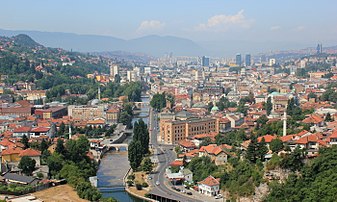
 Sarajevo (names in different dialects) is the capital[6] and biggest city of Bosnia and Herzegovina, with a populace of 275,524 in its current managerial limits.[5] The Sarajevo metropolitan zone, including Sarajevo Canton and East Sarajevo is home to 688,384[7] occupants. Settled inside the more prominent Sarajevo valley of Bosnia, it is encompassed by the Dinaric Alps and arranged along the Miljacka River in the heart of Southeastern Europe and the Balkans.

Sarajevo is the main political, social and social focus of Bosnia and Herzegovina, a conspicuous focal point of culture in the Balkans, with its area wide impact in excitement, media, form, and the arts.[8][9]

Because of its long and rich history of religious and social assortment, Sarajevo was some of the time called the "Jerusalem of Europe"[1] or "Jerusalem of the Balkans".[2] It is the main significant European city to have a mosque, Catholic church, Orthodox church and synagogue inside the same neighbourhood.[10] A local focus in training, the city is likewise home to the Balkans' first foundation of tertiary instruction as an Islamic polytechnic called the Saraybosna Osmanlı Medrese, today part of the University of Sarajevo.[11][12]

In spite of the fact that settlement in the range extends back to ancient circumstances, the cutting edge city emerged as an Ottoman fortification in the fifteenth century.[13] Sarajevo has pulled in worldwide consideration a few circumstances all through its history. In 1885, Sarajevo was the main city in Europe and the second city on the planet to have a full-time electric cable car organize going through the city, taking after San Francisco.[14] In 1914, it was the site of the death of Archduke Franz Ferdinand of Austria that started World War I, after which the city encountered a time of stagnation as a component of the Kingdom of Yugoslavia. The foundation of the Socialist Republic of Bosnia and Herzegovina inside the Second Yugoslavia prompted to an enormous development of Sarajevo, the constituent republic's capital, which facilitated the 1984 Winter Olympics. For almost four years, from 1992 to 1996, the city endured the longest attack of a city ever (1,425 days in length) amid the Bosnian War and the separation of Yugoslavia.[15]

Sarajevo has been experiencing post-war remaking, and is the quickest developing city in Bosnia and Herzegovina.[16] The travel manage arrangement, Lonely Planet, has named Sarajevo as the 43rd best city in the world,[17] and in December 2009 recorded Sarajevo as one of the main ten urban areas to visit in 2010.[18] In 2011, Sarajevo was named to be the European Capital of Culture in 2014 and will have the European Youth Olympic Festival in 2019.[19][20]

he soonest known name for the extensive focal Bosnian locale of today's Sarajevo is Vrhbosna.[3]

Sarajevo is a slavicized word in view of saray, the Turkish word for palace[21] (the letter J in the Bosnian dialect is proportionate soundwise to the English Y). The evo segment may originate from the term saray ovası initially recorded in 1455,[22] signifying "the fields around the royal residence" or essentially "castle plains".[23] However, in his Dictionary of Turkish loanwords, Abdulah Škaljić keeps up that the "evo" completion will probably have originated from the across the board Slavic addition "evo" used to show put names, than from the Turkish closure "ova", as proposed by some.[24] The main specify of name Sarajevo was in 1507 letter composed by Feriz Beg.[25]

Sarajevo has had many epithets. The most punctual is Šeher, which is the term Isa-Beg Ishaković used to portray the town he would fabricate. It is a Turkish word meaning a propelled city of key significance (şehir) which thus originates from Persian: شهر‎‎ shahr (city). As Sarajevo built up, various epithets originated from correlations with different urban communities in the Islamic world, i.e. "Damascus of the North". The most mainstream of these was "European Jerusalem".

Some contend that a more right interpretation of saray is government office or house. Saray is a typical word in Turkish for a royal residence or chateau (from Persian word سرای sarāy, signifies "house, castle").

Sarajevo is situated close to the geometric focus of the triangular-formed Bosnia-Herzegovina and inside the verifiable locale of Bosnia appropriate. It is arranged 518 meters (1,699 ft) above ocean level and lies in the Sarajevo valley, amidst the Dinaric Alps.[26] The valley itself once shaped an endless span of greenery, yet offered approach to urban extension and advancement in the post-World War II time. The city is encompassed by vigorously forested slopes and five noteworthy mountains. The most astounding of the encompassing pinnacles is Treskavica at 2,088 meters (6,850 ft), then Bjelašnica mountain at 2,067 meters (6,781 ft), Jahorina at 1,913 meters (6,276 ft), Trebević at 1,627 meters (5,338 ft), with 1,502 meters (4,928 ft) Igman being the briefest. The last four are otherwise called the Olympic Mountains of Sarajevo (see additionally 1984 Winter Olympics). The city itself has what's coming to its of bumpy landscape, as confirm by the many steeply slanted lanes and living arrangements apparently roosted on the slopes.

The Miljacka waterway is one of the city's boss geographic elements. It moves through the city from east through the focal point of Sarajevo to west piece of city where in the long run gets together with the Bosna stream. Miljacka waterway is "The Sarajevo River", with its source (Vrelo Miljacke) 2 kilometers (1.2 miles) south of the town of Pale[27] at the foothills of Mount Jahorina, a few kilometers toward the east of Sarajevo focus. The Bosna's source, Vrelo Bosne close Ilidža (west Sarajevo), is another outstanding common milestone and a prevalent goal for Sarajevans and different travelers. A few littler waterways and streams, for example, Koševski Potok additionally gone through the city and its region.

Cityscape

Sarajevo is found near the focal point of the triangular state of Bosnia and Herzegovina in southeastern Europe. Sarajevo city legitimate comprises of four regions (or "in Bosnian and Croatian: općina, in Serbian: opština"): Centar (Center), Novi Grad (New City), Novo Sarajevo (New Sarajevo), and Stari Grad (Old City), while Metropolitan range of Sarajevo (Greater Sarajevo zone) incorporates these and the neighboring districts of Ilidža, Hadžići, Vogošća and Ilijaš (before the war and new (Dayton-forced) regulatory division, Metro of Sarajevo comprised likewise, alongside previously mentioned, three regions today's partitioned between Federacija Bosne i Hercegovine and Republika Srpska – Trnovo, Federacija Bosne i Hercegovine/Trnovo, Republika Srpska, Lukavica and Pale). The city has a urban zone of 1,041.5 square kilometers (402.1 sq mi). Veliki Park (Great stop) is the biggest green territory in the focal point of Sarajevo. It's settled between Titova, Koševo, Džidžikovac, Tina Ujevića and Trampina Streets and in the lower part there is a landmark devoted to the Children of Sarajevo.

Atmosphere

Sarajevo has a sticky mainland atmosphere. Sarajevo's atmosphere displays impacts of maritime zones, with four seasons and consistently spread precipitation. The vicinity of the Adriatic Sea conservatives Sarajevo's atmosphere to some degree, despite the fact that the mountains toward the south of the city incredibly lessen this oceanic influence.[28] The normal yearly temperature is 10 °C (50 °F), with January (−0.5 °C (31.1 °F) avg.) being the coldest month of the year and July (19.7 °C (67.5 °F) avg.) the hottest.

The most noteworthy recorded temperature was 40.7 °C (105 °F) on 19 August 1946, and on 23 August 2008 (41.0) while the least recorded temperature was −26.2 °C (−15.2 °F) on 25 January 1942. By and large, Sarajevo has 6 days where the temperature surpasses 32 °C (89.6 °F) and 4 days where the temperature drops underneath −15 °C (5 °F) per year.[29] The city ordinarily encounters somewhat shady skies, with a normal yearly overcast front of 45%.

The cloudiest month is December (75% normal overcast cover) while the clearest is August (37%). Direct precipitation happens decently reliably consistently, with a normal 75 days of precipitation. Appropriate climatic conditions have permitted winter games to thrive in the area, as exemplified by the Winter Olympics in 1984 that were praised in Sarajevo. Normal winds are 28–48 km/h (17–30 mph) and the city has 1,769 hours of daylight.

One of the soonest discoveries of settlement in the Sarajevo region is that of the Neolithic Butmir culture. The revelations at Butmir were made on the grounds of the advanced Sarajevo suburb Ilidža in 1893 by Austro-Hungarian powers amid the development of a horticultural school. The territory's abundance in rock was appealing to Neolithic people, and the settlement prospered. The settlement created remarkable earthenware production and stoneware outlines, which portray the Butmir individuals as a one of a kind culture, as depicted at the International Congress of Archeologists and Anthropologists meeting in Sarajevo in 1894.[32]

The following unmistakable culture in Sarajevo were the Illyrians. The antiquated individuals, who considered the greater part of the West Balkans as their country, had a few key settlements in the locale, generally around the waterway Miljacka and the Sarajevo valley. The Illyrians in the Sarajevo locale had a place with the Daesitiates, the last Illyrian individuals in Bosnia and Herzegovina to oppose Roman occupation. Their annihilation by the Roman ruler Tiberius in 9 A.D. marks the begin of Roman govern in the locale. The Romans never developed the locale of cutting edge Bosnia, however the Roman province of Aquae Sulphurae was situated close to the highest point of present-day Ilidža, and was the most imperative settlement of the time.[33] After the Romans, the Goths settled the range, trailed by the Slavs in the seventh century.[34]


Tuzla

Tuzla


Tuzla is a city in Bosnia and Herzegovina. It is the seat of the Tuzla Canton and is the financial, logical, social, instructive, wellbeing and vacationer focus of upper east Bosnia.[1] After Sarajevo and Banja Luka, Tuzla is the third biggest city in Bosnia and Herzegovina. Preparatory outcomes from the 2013 Census demonstrate that the region has a populace of 120,441.[2]

Tuzla is an instructive focus and is home to two colleges. It is likewise the primary mechanical machine and one of the main monetary fortifications of Bosnia with a wide and fluctuated modern division including a growing administration part on account of its salt lake tourism. The city of Tuzla is home to Europe's just salt lake as a major aspect of its focal stop and has more than 100,000 individuals going to its shores each year.The history of the city does a reversal to the ninth century; present day Tuzla goes back to 1510 when it turned into a vital battalion town in the Ottoman Empire.

In Bosnia and Herzegovina, Tuzla is likewise viewed as a standout amongst the most multicultural urban communities in the nation and has figured out how to keep the pluralist character of the city all through the Bosnian War and after, with Bosniaks, Serbs, Croats and a little minority of Bosnian Jews dwelling in Tuzla

The name "Tuzla" is the Ottoman Turkish word for salt mine, tuzla, and alludes to the broad salt stores found underneath the city.

Archeological confirmation recommends that Tuzla was a rich Neolithic settlement. Being occupied persistently for over 6,000 years, Tuzla is one of the most seasoned European managed settlements. Amid the time of the Roman Republic (before the range was vanquished by Rome), Tuzla (or Salines as it was called at the time) was governed by the Illyrian tribe Breuci.[6]

The city was initially said in 950 by Constantine Porphyrogenitus in his De Administrando Imperio as a fortress named Salines (Greek: Σαλήνες). The name Soli was utilized as a part of the Middle Ages. It signifies "salts" in Bosnian and the city's available name signifies "place of salt" in Ottoman Turkish.[7] During the Middle Ages it had a place generally with the medieval Kingdom of Bosnia.

After the fall of the kingdom to the Ottoman Empire in 1463, the area was controlled by the House of Berislavić before the Ottomans possessed the towns of "Gornje Soli" and "Donje Soli" around 1512, and took control of the whole Usora in the 1530s.

It stayed under Ottoman manage for almost 400 years, where it was regulated as a major aspect of the Sanjak of Zvornik. In 1878 it was added by Austria-Hungary. After the disintegration of the government it turned into the part of the recently shaped Kingdom of Yugoslavia. The Husino uprising occurred in 1920.

In December 1944, the city was unsuccessfully assaulted by Chetnik powers of Draža Mihailović alongside the Serbian Assault Corps.[8][9] After the war it formed into a noteworthy modern and social focus amid the Communist time frame in the previous Yugoslavia.

n the 1990 races the Reformists won control of the region being the main region in Bosnia where non-patriots won. Amid the Bosnian war for autonomy between 1992–95 the town was the main district not administered by patriot powers. After Bosnia and Herzegovina proclaimed freedom and was perceived by the United Nations the city was blockaded by patriot Serbian strengths. A couple days after the fact Serbian strengths assaulted Tuzla. The town was not saved the outrages of the Bosnian war.

Sparkasse Bank of Tuzla.

1992 Yugoslav People's Army segment occurrence in Tuzla was an assault on the 92nd Yugoslav People's Army (JNA) Motorized Brigade in the city of Tuzla that occurred on 15 May 1992. The occurrence happened at the street intersection of Brčanska Malta as the JNA was experiencing a settled upon withdrawal from the city. No less than 50 individuals from the JNA were slaughtered and 44 injured amid the assaults.

On 25 May 1995, an assault on Tuzla murdered 71 individuals and harmed 200 people in what is alluded to as the Tuzla slaughter, when a shell hit the focal road and its promenade. The most youthful non military personnel who kicked the bucket in that slaughter was just two years of age.

Taking after the Dayton Peace Accords, Tuzla was the central command of the U.S. strengths for the Multinational Division (MND) amid Operation Joint Endeavor IFOR and consequent SFOR.

Tuzla is situated in the northeastern piece of Bosnia, settled just underneath the Majevica mountain extend, on the Jala River. The focal zone lies in an east-west arranged plain, with neighborhoods in the north and south of the city situated on the Ilinčica, Kicelj and Gradina Hills. It is 237 meters (778 feet) above ocean level. The atmosphere is direct mainland. There are plenteous coal stores in the district around Tuzla. 6 coal mines keep on operating around the city. A great part of the coal mined in the territory is utilized to control the Tuzla Power Plant, which is the biggest power plant in Bosnia and Herzegovina.

Extractions of the city's salt stores, especially in the twentieth century, have brought on areas of the downtown area to sink. Structures in the "sinking range" either caved in or were obliterated, and there are few structures in the city that originate before the twentieth century, regardless of the way that the city was established more than 1000 years prior.

Tuzla is the main city in Europe that has a salt lake at its middle. The old Pannonian Sea became scarce around 10 million years prior, however work by specialists and researchers has now empowered a level of saline water to be kept stable at the surface, and in 2003 the Pannonian Lake was opened.

A moment lake that incorporates fake waterfalls was initiated in 2008. An archeological stop and copy Neolithic lake homes were likewise joined into the plan, giving data about the distinctive societies which left their material and otherworldly check here. The site has turned into a universal traveler destination.[10]

A third lake was finished in August 2012. Development costs for this were almost 2 million Bosnian imprints (ca. 1 million euros). This third lake likewise contains 2 water slides which are a fascination for the more youthful populace.

The late spring period of 2013 recorded roughly 5,000 guests for each day (c. 450,000 for 3 months).[

A standout amongst the most powerful essayists in the Balkans, Meša Selimović hails from Tuzla, and Tuzla has the yearly Meša Selimović book celebration in July, where a honor for the best novel written in the dialects of Bosnia and Herzegovina, Croatia, Serbia and Montenegro is displayed.

The principal proficient theater in Tuzla, Narodno Pozorište u Tuzli (The National Theater of Tuzla), was established by the siblings Mihajlo and Živko Crnogorčević in 1898 amid Austro-Hungarian lead, and is the most seasoned theater in the nation. The theater is working persistently since 1944.

The Portrait Gallery has constant displays of work by nearby and universal craftsmen.

The Ismet Mujezinović Gallery is essentially devoted to the late Ismet Mujezinović, a well known painter from Tuzla.

The Eastern Bosnia Museum displays archeological, ethnological, recorded and aesthetic pieces and relics from the entire area.

An outdoors gallery at Solni Trg, opened in 2004, recounts the account of salt creation in Tuzla.

Aside from Tuzla's numerous mosques, there is additionally an Orthodox church that went untouched all through the war.[14]

The Franciscan religious community nearby is still extremely dynamic as there is a sizable Catholic people group in Tuzla. Simply outside the town, in the adjacent town of Breska, is a 200-year-old Catholic church.[14] Tuzla is likewise home to an old Jewish graveyard which as of late experienced redesigns, sorted out by the OPEN Organization of Tuzla and the Jewish Municipality of Tuzla.[15]

petak, 11. studenoga 2016.

Nova generacija Scania kamiona u januaru na bh. tržištu


https://i.ytimg.com/vi/kUWoUxs5OBc/maxresdefault.jpg


Nova generacija Scania kamiona u januaru na bh. tržištu#ad-image-0
Scania BH d.o.o ove godine obilježava 125 godina postojanja kompanije.
Tim povodom, Scania je nedavno predstavila novu generaciju kamiona R serije i uvela novu S seriju, a novi kamion je kruna 10-godišnjeg razvoja i ulaganja od dvije milijarde eura.
Sa novom serijom kamiona priliku da se upoznaju imali si u posjetitelji sajma RENEXPO, na kojem se Scania BH predstavila i ove godine.
“Serija S predstavlja potpuno nova kabina sa ravnim podom što naši kupci do sada nisu imali prilike da vide kada je konkretno Scania u pitanju i predstavlja novitet koji redefiniše kamionski svijet”, kazao je  Dejan Koleška, direktor Scania BH d.o.o. za portal Akta.ba, dodajući da su unaprijeđena aerodinamika te optimirani motori rezultirali ne samo sjajnim kamionom, već i s 5% manjom potrošnjom goriva što konkurencija neće lako dostići.
Ističe da je svjetska prezentacija kamiona bila u augustu, te da su sa kupcima posjetili fabriku u septembru.
“Prve narudžbe su već stigle, a isporuka se očekuje u januaru iduće godine”, potvrdio je on za naš portal.
Naglašava da su brojne mogućnosti novog kamiona, te da Scania najavljuje i brojne usluge, namijenjene optimizaciji, ekonomičnosti i zaštiti okoliša.
Kada je u pitanju održivost u transportu i trend smanjenja emisije štetnih gasova, odnosno CO2, Scania tu ima vodeću poziciju..
Ističe da se tu ne misli samo na alternativni pogon, već i na energetsku efikasnost vozila, način korištenja tih vozila, trening vozača i svim onim drugim načinima koji doprinose smanjenu zagađena naše okoline.
“Tako ćemo ispred Scanie predstaviti vozila sa alternativnim gorivima kao što su H2O, biodizel, LPG itd. Ono što je također trend koji pratimo u cilju korištenja vozila je “plateauing”, zatim vozila koja koriste kombinovani pogon tzv. hibridi. Pored obuke vozača i povećanja efikasnosti tih vozača, dalji trendovi su vezani za autonomna vozila, odnosno da kamioni voze samostalno bez vozača. To smo dokazali na određenim rudnicima i površinskim kopovima gdje vozila, sa određenim unaprijed unesenim rutama, samostalno rade bez vozača”, pojašnjava Koleška.
Iz ove kompanije naglašavaju da se danas proizvođači ne oslanjaju samo na pogonski sklop, već i na ostale proizvode i sisteme kojim obilježavaju savremeni transport.
Scania BH d.o.o. posluje u Bosni i Hercegovini od 2000. godine. Organizovani su kroz servisne centre u Sarajevu i Banjoj Luci i nude kompletnu paletu proizvoda od teških kamiona za međunarodni transport, lokalnu distribuciju, građevinu i specijalne namjene, do gradskih i međugradskih autobusa kao i industrijskih i brodskih motora.

petak, 28. listopada 2016.

Prevoz kakav još niste videli!

Rezultat slika za Prevoz kakav još niste videli!

Kada imate puno stvari koje treba da prevezete od mesta A do mesta B, potrebno je pozvati specijalizovane službe koje se time bave. Ovaj čovek odlučio je da preuzme stvar u svoje ruke, a oni što vidimo na fotografijama zaista izgleda zastrašujuće…
On je na platformu prvog kamiona natovario jedan manji kamion, a zatim na njega još jedan manji. To nije kraj, jer je na manji kamion stavio pick-up, a u pick-upu još jedno iznenađenje – motocikl.
Problem je, što bi jedan oštriji manevar značio da vozila spadnu dole sa kamiona, ali to se ne događa. Još jedno pitanje je, kako su ova vozila dospela na kamion. Izvor: novosti-glox.blogspot.ba